The AI Infrastructure Stack, Layer by Layer
NVIDIA gets the headlines, but the AI buildout runs through memory chips, networking gear, data centers, power plants and the grid. Here's every layer, and why it eventually shows up in your AI bill.
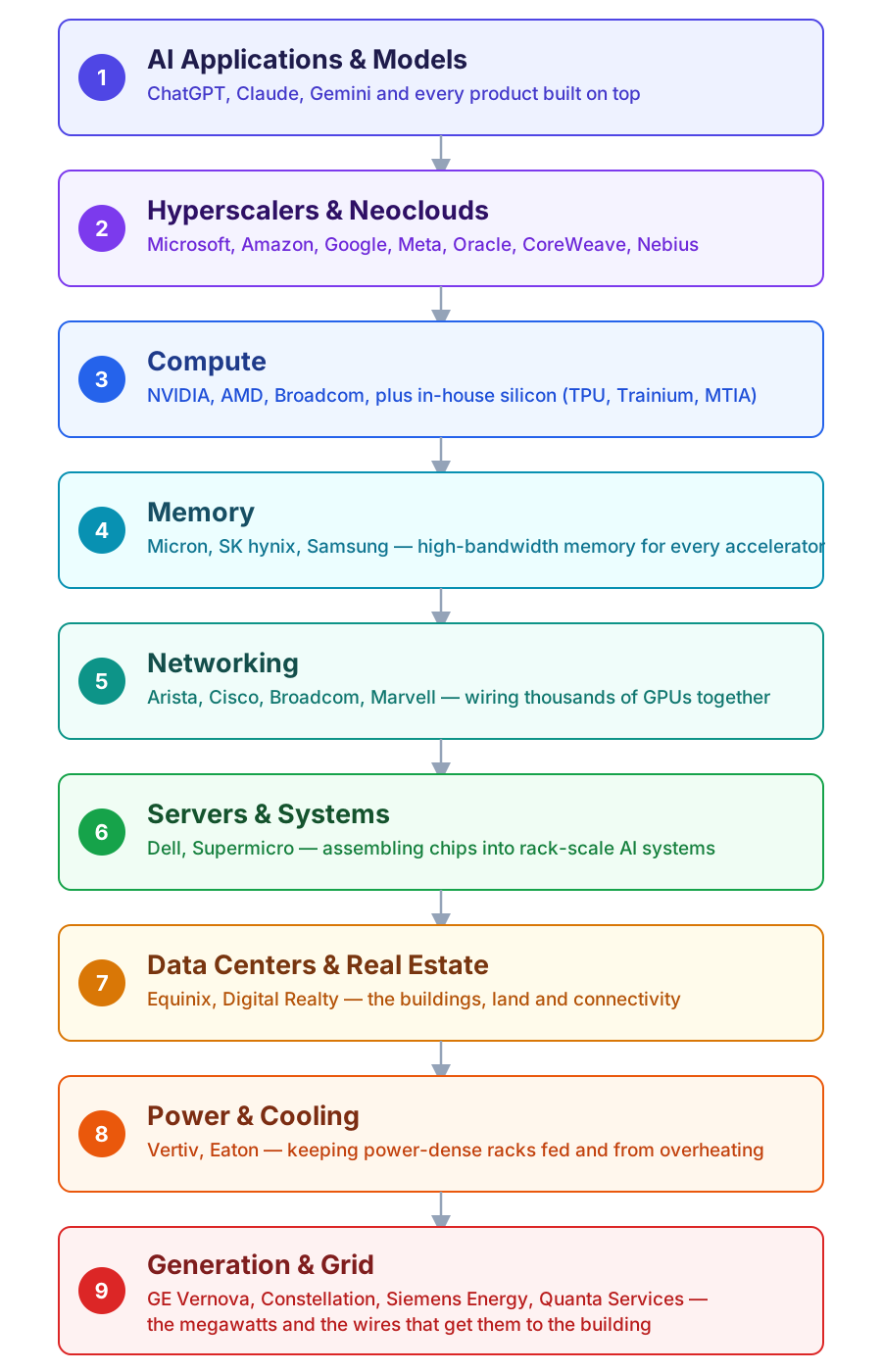
Four companies plan to spend $725 billion on AI infrastructure in 2026, up 77 percent from last year's already-record $410 billion. Almost none of that money buys software. It buys chips, memory, cabling, buildings, transformers, and increasingly, power plants.
Every AI subscription you compare on this site sits on top of that spending. A neocloud's hourly GPU rate, a chatbot's monthly fee, a coding assistant's per-seat price: all of it eventually traces back to how much it costs someone to build and run the physical stack underneath. Understanding that stack explains why AI pricing moves the way it does, and where the next bottleneck is likely to show up.
Compute Is the Layer Everyone Sees
NVIDIA still anchors this layer, supplying the GPUs, networking gear and software stack most large AI clusters are built around. But the layer isn't a monopoly anymore. AMD is fighting for accelerator market share, and Broadcom's AI semiconductor revenue keeps climbing as hyperscalers design their own custom silicon around it. Google has TPUs, Amazon has Trainium and Inferentia, Meta has MTIA. Every major buyer is hedging against depending on one supplier.
That hedge matters more than it looks. It means the compute layer isn't one company's pricing power, it's a competition between at least four architectures, and that competition is what keeps GPU-hour prices from just floating upward forever.
Memory, Networking and Assembly: the Layers Nobody Photographs
A GPU with nothing to read is an expensive space heater. High-bandwidth memory (HBM) from Micron, SK hynix and Samsung determines how fast an accelerator can actually feed itself data, and as models grow, the memory bill per chip grows with them. Few outside the industry track HBM pricing, but it moves AI hardware costs as much as the chip itself.
Connect thousands of those chips together and you need networking that doesn't buckle: Arista, Cisco, Broadcom and Marvell all sell into this layer, and as clusters scale from thousands of GPUs toward frontier-scale systems, bandwidth and latency become the constraint, not raw chip count. Then someone has to physically assemble processors, memory, networking and cooling into a working rack. That's Dell and Supermicro's layer, the bridge between components on a spec sheet and a system that actually boots.
| Layer | What it does | Who sells into it |
|---|---|---|
| Compute | GPUs and custom AI accelerators | NVIDIA, AMD, Broadcom |
| Memory | High-bandwidth memory for accelerators | Micron, SK hynix, Samsung |
| Networking | Connects thousands of chips into one cluster | Arista, Cisco, Marvell |
| Servers | Assembles components into rack-scale systems | Dell, Supermicro |
| Data centers | Physical facilities and connectivity | Equinix, Digital Realty |
| Neoclouds | Rents GPU capacity without owning the model | CoreWeave, Nebius, RunPod |
| Power & cooling | Delivers electricity, removes heat from dense racks | Vertiv, Eaton |
| Generation | Produces the electricity itself | GE Vernova, Constellation, Siemens Energy |
| Grid | Transmission and distribution to the site | Quanta Services, regional utilities |
Data Centers and the Rise of the Neocloud
All of that hardware needs somewhere to sit. Equinix and Digital Realty provide the buildings and connectivity; hyperscalers like Microsoft, Amazon, Alphabet and Meta build enormous amounts of their own facilities on top of that base layer, with Oracle expanding aggressively into the same territory.
A newer category sits between the two: neoclouds. Companies like CoreWeave and Nebius don't build general-purpose cloud platforms, they concentrate entirely on AI compute, which is why CoreWeave now carries a $14.2 billion compute agreement with Meta and Nebius picked up $3 billion from the same customer. We ranked ten of these GPU-rental providers by actual hourly price, and the spread between the cheapest and most expensive is over 3x for identical hardware, evidence that "neocloud" describes a pricing philosophy as much as a product category.
Best for: anyone trying to understand why a RunPod H100 costs $2.49/hour while a CoreWeave one costs $6.16. Same chip, different layer of the same stack. Compare RunPod's current rates →
The Bottleneck Moved to Electricity
This is the part most AI coverage skips. AI racks are getting denser and hotter, which is why Vertiv and Eaton (power delivery and cooling infrastructure) have become as relevant to AI investment as any chipmaker. More compute means more electricity, more electricity means more heat, more heat means more cooling. The bottleneck keeps moving downstream, and right now it has landed on the grid itself.
US data center power demand is projected to climb from 31 gigawatts in 2025 to 41 gigawatts in 2026 and 66 gigawatts by 2027. In Texas alone, roughly 90 percent of the 474 gigawatts of large-load interconnection requests currently under review come from data center projects, and ERCOT expects data-center-driven demand there to exceed 40 gigawatts by 2028. A single AI data center can now draw 100 to 750 megawatts, comparable to a mid-sized city.
When grid connections take years and GPU demand doesn't wait, developers turn to on-site generation instead. That's a cost that eventually flows into the price of every AI product built on that capacity.
Generation: Gas, Nuclear and Whatever Is Fastest
Traditional grid expansion can take years. AI compute demand doesn't wait that long, so developers are increasingly sourcing power directly. GE Vernova and Siemens Energy supply gas turbines that can be stood up faster than new transmission lines, and demand for those turbines tied to data center development has been running strong through 2026.
Nuclear is the other lever, specifically because AI data centers need power that doesn't fluctuate. Constellation Energy, the largest US nuclear operator, and Vistra have both become direct beneficiaries of tech companies signing long-term power agreements, with Cameco providing exposure further upstream on the uranium fuel side. Natural gas producers and pipeline operators like Williams and National Fuel sit in the same story: some data center developers are now building "behind-the-meter" generation on-site rather than waiting on a queue.
The Grid Is the Last Mile
None of this new generation matters if the electricity can't get to the building. Transformers, substations and transmission lines are now a genuine constraint on how fast AI infrastructure can come online, which is why Eaton, GE Vernova and Quanta Services (which builds and maintains the physical transmission network) are as tied to AI growth as any semiconductor company. The bottleneck for the next AI cluster increasingly isn't chip supply. It's megawatts and permits.
Why a Pricing Site Cares About Power Plants
AI tool pricing looks like a software decision from the outside: a monthly plan, a per-seat fee, a token rate. Underneath, it's a claim on physical capacity that took years and tens of billions of dollars to build. When a model provider raises prices, cuts a free tier, or a GPU cloud's rate creeps upward, it's rarely arbitrary. It's usually the infrastructure layer passing its own cost increase upstream to you.
That's the actual argument for tracking this stack, not as a stock-picking exercise, but as context. The tools you compare on pricing pages are downstream of a supply chain running from a fab in Taiwan to a substation in Texas. Knowing where that chain is tight tells you which AI price increases are temporary and which ones are structural.
FAQ
What is the AI infrastructure stack? +
The full physical supply chain behind AI products: compute chips, memory, networking, servers, data centers, and the power generation and grid infrastructure that keeps all of it running. Software sits on top; the stack is everything underneath.
Why is electricity becoming the bottleneck for AI instead of GPUs?
Chip supply has scaled up over the past few years, but grid connections and new power generation take years to build. US data center power demand is projected to nearly double from 31 gigawatts in 2025 to 66 gigawatts by 2027, faster than most grids can expand.
What's the difference between a hyperscaler and a neocloud?
Hyperscalers (Microsoft, Amazon, Google, Meta) run general-purpose cloud platforms with AI as one workload among many. Neoclouds like CoreWeave, Nebius and RunPod are built specifically for AI compute, with pricing that varies significantly depending on scale and contract structure.
Why are nuclear and natural gas companies tied to AI growth?
AI data centers need power that's both large in volume and consistent around the clock. Nuclear operators like Constellation and gas turbine suppliers like GE Vernova can deliver that reliability faster than waiting on new transmission infrastructure, which is why both sectors have picked up direct deals with AI infrastructure developers.
How much are hyperscalers spending on AI infrastructure in 2026?
Microsoft, Amazon, Alphabet and Meta collectively planned roughly $725 billion in capital expenditure for 2026, up 77 percent from 2025's $410 billion, with nearly all of it going toward GPU clusters, custom silicon and data center construction.
Does infrastructure spending actually affect what I pay for AI tools?
Indirectly, yes. Compute cost is the largest input for most AI products. When GPU rental rates or power costs rise at the infrastructure layer, that cost tends to show up later as a price increase, a smaller free tier, or usage caps on the product you're subscribed to.
Community Comments
Used AI Infrastructure? Sign in with Google and share your honest experience. New comments are reviewed before they appear.
No comments yet. Be the first to review AI Infrastructure.